
This paper is presented as a critical commentary based on public records, firsthand testimony, and publicly available content. It is offered as part of an ongoing investigation into the ethics and outcomes of unregulated custody coaching. No claim is made about Tina Swithin and/or Annie Kenny’s private actions beyond what is cited, sourced, or directly observed.
Introduction
Unregulated custody coaching has become one of the most dangerous industries to emerge from the cracks of family court. It thrives on the desperation of parents, the confusion of custody litigation, and the emotional pull of trauma narratives. At the center of this ecosystem are names like Tina Swithin and Annie Kenny. Both women present themselves as advocates, mentors, and experts for protective parents. Both profit from selling stories of victimhood and resilience. And both have carefully curated public personas that collapse under the weight of their own paper trails.
This exposé consolidates court filings, financial records, investigative reports, and direct public content to document a pattern of contradictions. The evidence shows how these coaching figures operate less like protectors of children and more like entrepreneurs of crisis. It is not enough to point to isolated contradictions. The record demands recognition of a systemic pattern that endangers families, misleads parents, and corrodes trust in genuine advocacy.
While this paper focuses on Swithin and Kenny as case studies, the intent is not to personalize the issue but to illuminate how trauma branding and unregulated coaching exploit families. Similar patterns exist across dozens of coaching businesses. The coaching cartel represents a broader structure of profit built on parental fear.
Part I. Tina Swithin and the Federal Defamation Lawsuit
On August 26, 2025, Christopher Ambrose, a protective father, filed a defamation complaint against Tina Swithin in the United States District Court of Connecticut, docket number 3:25-cv-01372 (United States District Court of Connecticut, 2025). The complaint alleges defamation, defamation per se, false light invasion of privacy, intentional infliction of emotional distress, and harassment. Ambrose is seeking one million dollars in damages and litigation costs.
The complaint details that Swithin repeatedly accused Ambrose of sexually, emotionally, and physically abusing his children despite court findings, hospital evaluations, and Department of Children and Families investigations that had already determined all allegations were false (United States District Court of Connecticut, 2025). Ambrose’s cease-and-desist letter provided her with documentation disproving the abuse allegations. Instead of retracting, she escalated. She threatened to conduct another “interview” with his daughter and proliferated videos online of children reciting scripted allegations (United States District Court of Connecticut, 2025).
This lawsuit is not an isolated case. Linda Gottlieb, LMFT, summarized Swithin’s pattern in her LinkedIn article “Tina Swithin Sued for Defaming A Protective Alienated Father,” published September 21, 2025. Gottlieb documented Swithin’s history of fabricating narratives, projecting abuse onto alienated parents, and interfering in custody cases, including instances where judges directly named her for unlawful meddling (Gottlieb, 2025). The lawsuit against her is the most direct accountability effort yet, but the allegations align with a long record of similar conduct.
Courts have long recognized that public figures who repeat disproven allegations risk not only reputational harm but also secondary harm to children who are drawn into repeated investigations (Martindale, 2010). The fact that Swithin escalated after being provided with exculpatory documentation illustrates not just negligence but willful disregard of evidence. Her anticipated defense will likely center on claims of advocacy, free speech, or belief in her sources. The counterpoint is clear: advocacy that ignores verified court findings and amplifies disproven allegations ceases to be protected speech and becomes actionable defamation.
Part II. The Financial Trail of Contradictions
Tina Swithin has consistently presented herself as a mother abandoned without support, forced to rebuild from nothing. That narrative fueled her blog, One Mom’s Battle, and her image as a survivor-turned-advocate. Public records and financial testimony tell a different story.
According to rebuttals filed by her ex-husband Damien Porter, Swithin received $220,681.60 in child support and assets over a ten-year period (Ripoff Report, 2020). Despite this, she repeatedly claimed in public forums that she received nothing. Porter also documented over 55 hearings between 2009 and 2019, where he consistently provided financial support while defending against her repeated motions (Ripoff Report, 2020).
The contradictions extend beyond support payments. Swithin claimed to suffer from Multiple Sclerosis during custody proceedings, later contradicted by neurologist evaluations diagnosing Lupus (Ripoff Report, 2020). She reported earning only $2,100 per month as an account executive, a figure disputed as deliberately lowered to manipulate California’s child support calculation system. During the same period, she lived in multimillion-dollar homes, employed full-time staff, and maintained a comfortable lifestyle (Ripoff Report, 2020).
Her business record follows the same trajectory. SLO County Sitters, her childcare agency, abruptly shut down, leaving 45 sitters unpaid and families out thousands of dollars in deposits, some losing as much as $2,500 each (Ripoff Report, 2020). No refunds were issued. This collapse mirrored the same pattern visible in her custody advocacy: extract funds, deny accountability, and pivot to a new platform built on the image of survival.
Critics will argue that Ripoff Report is not a formal legal source. That is true. What strengthens these claims is the overlap between the allegations and her public pattern of contradictions, coupled with corroborating financial testimony and court filings. In consumer protection terms, a consistent misrepresentation of income and financial hardship while actively monetizing a victim narrative constitutes deceptive practice (Federal Trade Commission, 2023).
Part III. Annie Kenny and the Bloom Consulting Brand
On July 13, 2025, Annie Kenny publicly endorsed the High Conflict Divorce Coach Certification Program, calling it the best decision she had ever made (Kenny, 2025). Just ten days earlier, her household became the subject of a custody motion in Charles County, Maryland. Public records show that her husband, John Edward Klopfer III, has struggled with addiction since 2015. In May 2025 he entered rehabilitation, in June he moved into sober living, in late June he was expelled, and by June 27 he was arrested for public intoxication in South Carolina (Charles County Circuit Court, 2025; Horry County Government, 2025).
The timing is not incidental. While Kenny promoted herself as a mentor and strategist for protective parents, she concealed that her own household was in active custody litigation involving addiction, incarceration, and instability. The concealment matters because Kenny is not an informal peer offering support. She sells coaching services for $547 per participant at Bloom Consulting workshops (Bloom Consulting Solutions, 2025). She is a featured voice in legislative discussions and collaborates directly with Tina Swithin. Clients purchasing her services are entitled to material facts about her household and credibility.
Kenny’s financial record adds to these concerns. She filed for bankruptcy in 2024 (U.S. Bankruptcy Court, 2024). After promoting a GoFundMe campaign citing ongoing legal expenses, she purchased a new SUV and financed construction of a home in South Carolina (GoFundMe, 2020–2025). This sequence raises questions about whether bankruptcy was used to shield assets while maintaining a narrative of financial victimhood.
Even more concerning are disclosures from Kenny’s teenage daughter, who publicly described abuse on Instagram in 2025. This disclosure is unrelated to the older daughter’s story that Kenny has repeatedly leveraged in her Bloom Consulting branding. While no parent is to blame for harm done to a child, the silence about this disclosure while actively selling herself as a guide for traumatized families underscores the contradiction.
As documented in my July 14, 2025 Weaponized Stepmom report, Kenny’s authority derives from her personal storytelling and peer certification rather than clinical or legal qualifications (Short, 2025). Her recruitment into the same coaching pipeline pioneered by Swithin shows how these narratives are recycled into profit-making structures that lack oversight.
The anticipated defense will be that her personal struggles are irrelevant to her capacity to support others. That defense collapses under the consumer protection principle of material misrepresentation. When one sells services on the basis of credibility and authority, concealing relevant household instability constitutes a deceptive omission (Federal Trade Commission, 2023).
Part IV. The Systemic Problem of Custody Coaching
Tina Swithin and Annie Kenny are not anomalies. They are case studies in how unregulated coaching infiltrates custody disputes. Their platforms operate like multi-level marketing schemes. Both recruit vulnerable parents into certification programs that promise authority and income. Both sell workshops, memberships, and one-on-one sessions at premium prices. Both rely on emotionally charged storytelling rather than professional credentials.
The structure preys on parents at their most vulnerable. It appeals to fear of losing children, distrust of the courts, and the allure of being part of an advocacy movement. But unlike licensed mental health professionals, attorneys, or court-appointed experts, these coaches are not bound by ethical codes, malpractice liability, or consumer protection standards. They can orchestrate public narratives, encourage parents to violate court orders, and manipulate evidence without facing professional consequences.
The result is a system where trauma becomes a product. Children are filmed, their disclosures are commodified, and their suffering is broadcast online under the guise of advocacy. Parents pay thousands for strategies that may worsen their custody cases. The emotional costs to families are incalculable.
Research in developmental psychology shows that repeated exposure to custodial conflict, especially through public displays such as online videos, directly harms children’s adjustment and long-term mental health (Johnston and Roseby, 1997; Emery, 2004). The use of children as props in advocacy movements compounds stress and can produce lasting attachment disruption. The Federal Trade Commission has also acknowledged in consumer warnings that coaching and mentorship programs exploiting personal trauma can constitute unfair and deceptive practices (FTC, 2023).
Conclusion
The stories of Tina Swithin and Annie Kenny converge into a single truth: the custody coaching industry is a business of contradictions. It markets safety while concealing instability. It profits from victimhood while exploiting families. It claims to empower parents while manipulating children.
The defamation lawsuit against Swithin, the financial and business records from her past, the custody filings involving Kenny, and the workshop fees charged to desperate parents all reveal the same playbook. This is not advocacy. It is commerce. Until custody coaching is regulated, licensed, and held accountable, families will continue to be exploited under the guise of support.
Regulation must include licensing requirements, malpractice liability, consumer fraud enforcement, and prohibitions against monetizing children’s disclosures. The FTC has existing authority to regulate deceptive practices, but state legislatures must also act to define custody coaching as a regulated service subject to oversight.
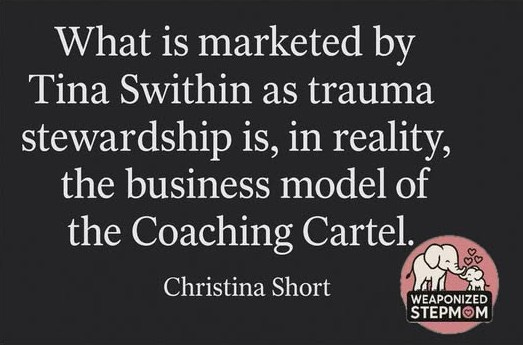
The paper trail speaks louder than the curated narratives. What is marketed as trauma stewardship is, in reality, trauma branding. Parents deserve the truth. Children deserve safety. Families deserve better than the Coaching Cartel.
References
Bloom Consulting Solutions. (2025). In-person workshop. https://www.bloomconsultingsolutions.com/in-person-workshop
Charles County Circuit Court. (2025). Consent Motion to Modify Legal Custody, Jill Alyssa Konopka v. John Edward Klopfer III (Case No. 08-C-13-002405).
Emery, R. E. (2004). The truth about children and divorce: Dealing with the emotions so you and your children can thrive. Penguin.
Federal Trade Commission. FTC.gov.
GoFundMe. (2020–2025). Help a mother fight for justice and save her children. https://www.gofundme.com/.../help-mother-fight-for...
Gottlieb, L. (2025, September 21). Tina Swithin sued for defaming a protective alienated father. LinkedIn.
Horry County Government. (2025). Detention Center Booking and Releases. https://www.horrycountysc.gov/.../detent.../booking-releases
Johnston, J. R., & Roseby, V. (1997). In the name of the child: A developmental approach to understanding and helping children of conflicted and violent divorce. Free Press.
Kahneman, D. (2011). Thinking, fast and slow. Farrar, Straus and Giroux.
Kenny, A. (2025, July 13). Facebook post. https://www.facebook.com/100082674734512/posts/746167988149019
Martindale, D. A. (2010). Cross-examining experts in the behavioral sciences. American Bar Association.
Ripoff Report. (2020). Damien Porter child support debt rebuttal.
https://www.ripoffreport.com
Short, C. (2025, July 14). If you’ve worked with Annie Kenny, you deserve to know this. Weaponized Stepmom.
United States District Court of Connecticut. (2025). Christopher Ambrose v. Tina Swithin (Case No. 3:25-cv-01372).
U.S. Bankruptcy Court, District of South Carolina. (2024). In re Annie Marie Kenny (Case No. 2:24-bk-00857).
Christina Short runs Weaponized Stepmom: Evidence-based advocacy for shared parenting. We expose the tactics used to control custody, highlight research on child well-being, and speak truth about blended families without fear. This is where accountability meets action.
If you’d like to contribute to Severed Voices, drop a comment and we’ll get in touch
